France: day 3 & 4

DAY 3

We had a few nervous moments with the car but, after a tasty (local and organic) breakfast we got underway with all systems go. Knowing we might not have time to stop for lunch (or, if we do, much time to eat dinner that night) we swung by a Leclerc store and bought the essentials: ham, cheese, jam, wine and baguette. By the way, in our first 48 in France we saw half a dozen people walking down the street carrying only a baguette. We’d see a dozen more over the next week. The French really do like their baguette.

We decided to stop at Chateau de Villandry, famous for its lovely gardens. In fact, we didn’t even visit the inside of the chateau, we just walked around in the massive gardens outside. There were lots of ornamental gardens, including a maze, but there’s an actual working farm portion too…they were harvesting vegetables when we visited. There were also piles of fish in their moat, which was weird…they come right out of the water looking for food, with their dead eyes, like a doll’s eyes…uh, ahem.

Anyway.

We kept driving, now right along the Loire. We saw a heron and the odd roadside cat and some kind of nuclear steam cloud (don’t ask) and navigated around a detour. That was to become a recurring theme. We finally reached the tiny town of Candes-St-Martin at the confluence of the Loire and the Vienne, and parked the car so we could walk to the hill above the town for a great view of the surrounding countryside. We got another great view when we walked down the riverside.

We kept heading west along the Loire and realized, just as we’d reached the town of Saumur, that we’d somehow missed the Chateau D’Ussé entirely. We didn’t spend much time in Saumur as we were tired and hungry and late and lost, so we ate lunch at some awful touristy place right next to the chateau.

We decided to skip the rest of the drive along the Loire, to Angers, and just bust north toward our next B&B. Carmen took us a crazy route (we told her to avoid toll highways, but still…she had us on some pretty hardcore back roads), and it didn’t help that we kept hitting detours, including a visit from the Gendarmerie. Eventually we got on to progressively bigger highways, and after a few minutes on our first autoroute we were in love. After driving 40 km/h through driveways and farm lanes all day, doing 140km/h in a straight line was pretty sweet. After a long day of driving we finally reached Les Blotteries.

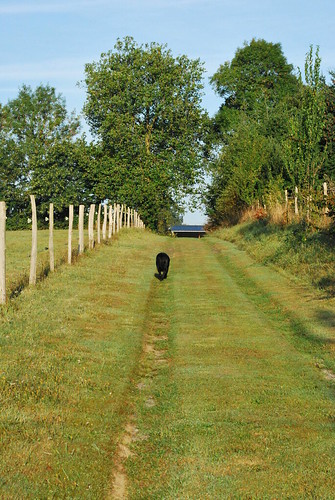
This was probably my favourite place of the whole trip. The house and farm were lovely, but the owner, Jean-Malo, and his dog (Madame Plume) made us feel like family the minute we arrived. We didn’t linger long that night as we decided to drive the 10 minutes to Mont Saint-Michel so we could take pictures of it at sunset.  We had to stop along the way to let a herd of sheep cross the road. Jean-Malo later insisted with a smirk that they just do that for the tourists.

We made our way back to Saint-James for dinner at the Lion D’Or, where we sampled wine from Saumur (the town redeemed itself!) before returning to Les Blotteries for a good night’s sleep. I actually didn’t want to leave the next morning after breakfast (and great conversation with his other house guest) but when the time came Jean-Malo sent us off with two bottles of locally-made apple juice, directions for a much prettier drive than we’d planned and a fresh croissant for the road. I missed he and Plume the moment we pulled away.

DAY 4

However, we had new adventures to get to. We took the scenic route Jean-Malo suggested, driving up the Atlantic coast toward Granville (with a semi-frantic detour in search of diesel) before turning northeast.

We stopped in Bayeux to see the famous Bayeux Tapestry and have lunch. It is at this lunch that I got myself a baddass mofo sunburn. From there we drove the short distance north to the Juno Beach Centre, a museum dedicated to the Canadian participation in the D-Day landing as well as all Canadian troops who served in WWII.

We arrived just in time to make the 3:00 tour, which is good, since it included a tour of the bunker on the beach. We find out about the museum, the sculptures, the bunker, the town and the beach itself. It’s not a bad little tour, and I have to admit to some chills when standing on the beach. There were tourists and fishermen walking up and down it when we were there, but standing at the water’s edge and looking toward the beach, it’s hard to believe someone actually mounted a successful attack that way. I couldn’t even imagine what it must have been like.

Tour finished, we called ahead to the next B&B to let them know we were coming. I had that conversation entirely in French, and realized I must be getting better at this. Five minutes later we were at the Le Mas Normand, meeting Christian and Mylene and their dogs.

Our room was tiny, but wonderful…we could see cows out one window, dogs out the other and the courtyard through our little dutch door. We didn’t have a chance to sample Christian’s cooking, so we had dinner at some bistrot in the town. When we got back to the B&B we weren’t tired, so we bundled up and sat in the courtyard and drank a bottle of wine like the party animals we are. The Belgian couple and American couple went to bed early; the two Canadian couples rolled home last, and we slept like the dead.

France: day 1 & 2

DAY 1

After a long and unpleasant flight (I couldn’t sleep and the food was rubbish) we landed in Paris. I was trying to stay lucid long enough to pick up the rental car and let Nellie, who’d at least managed a few hours of shut-eye on the flight, drive to Chartres. All went well and we got on the road soon enough, thankfully with a GPS to show us the way. We named it Carmen. Carmen the Garmin.

After fighting through Paris traffic we took the relatively smooth road to Chartres, about 90 minutes from Paris, and parked the car. We had several hours to kill before we could backtrack to our B&B (because really, all we wanted to do at this point was sleep) so we had some lunch at a brasserie on a square, struggling to adapt to having to speak French all of a sudden. After lunch we found the famous Chartres Cathedral.

It’s an impressive building, both inside and out, and one of only two I was interested in seeing on this trip. After seeing it we wandered around Chartres a little more, picking up some food for the evening since we knew we wouldn’t stay awake long enough to eat a proper dinner. We got back to the car and drove the half hour or so to our B&B, La Ferme de Bouchement.

When we arrived there was no one there to answer the door, teaching us a valuable lesson for the rest of the trip: always call ahead to a B&B. We waited for a while, knocking on various doors and windows, until finally one of the owners arrived. This is where my cloudy brain really had to switch back to French mode, as Didier didn’t speak very much English at all. However, I understood everything he said and we managed to get the car parked and bags up to the room. The grounds were lovely with cats, a dog and several ducks inhabiting the back yard. We snapped some pictures, then laid our weary bones on the wonderful bed and went to sleep.

DAY 2

Nellie and I being the planners that we are, we’d begun adjusting our body clocks a week before leaving, so that (sleepless transatlantic flights aside) we wouldn’t have jet lag. Thus, we sprung from our beds ready to bust south toward the Loire Valley. However, after eating breakfast and meeting Didier’s wife, we learned another valuable lesson: B&Bs in the middle of nowhere don’t often accept credit cards. Duh. So we drove about fifteen minutes north to a little town (and sadly forgot to bring one of our cameras as we parked right next to a half-standing medieval tower…hard to describe but it was very cool) to find an ATM, took out some cash and sallied forth, nearly an hour later than we’d planned. No matter, we didn’t have far to go that day. We took the scenic route (through Beaugency) to Chateau de Chambord.

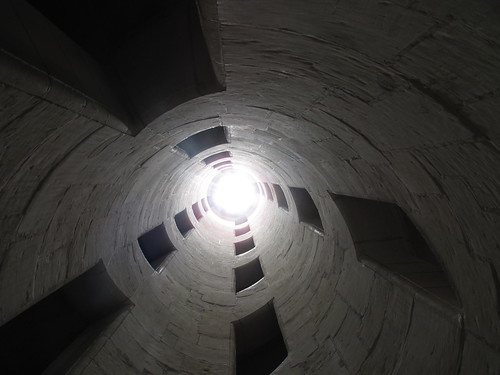
Chambord is one of the largest and most magnificent chateaux along the Loire valley. We took our time there, getting plenty of good shots inside and out, including the double-helix staircase in the centre of the chateau.

In that picture I was shooting up through the center of the staircases, toward the sunlight. Speaking of sunlight, it’s worth mentioning: for the entire two weeks we were in France the weather was spectacular. The first week it was sunny and in the mid- to high-20s, and only in the last few days did it become overcast and go as low as the mid-teens. The only rain we saw was light mist one day while driving. We never got a drop of rain on us the whole time.

Anyway, from Chambord we drove to Blois for some lunch. It was a lovely city, at least the small bit that we saw from our touristy cafe and the ramparts overlooking the river. We accidentally ordered too much wine, so Nellie had to drive the rest of the way whilst I got good and tipsy in the afternoon sun. Good times. Anyway, from there it was a short drive along the Loire to our next B&B, which wasn’t very easy to find, but was well worth it.

The Chateau de Nazelles, across the river from Amboise and at the top of a hill, is actually a reconstructed old castle. Our room, the Troglodyte suite, was carved into the side of a hill, so I guess that means we slept in a cave. The place was lovely, lots of greenery and old walls and animals about, and modern luxuries like wi-fi and a place to keep drinks cold. With a great recommendation from one of the owners, we had a fantastic dinner just down the road at the Auberge de Launay. It set the bar very, very high for the rest of the trip, and establishes a go-to wine region for the rest of our time in France: Chinon.

The next day promised to be a bad-ass haul along the Loire and all the way up to Basse-Normandie, so we digested our food as quickly as we could and hit the sack.

Au revoir, France

Home again. Tired, off-kilter and not looking forward to all the stuff I need to do, but man…what a great trip.

We’ll sort through all the pictures and everything soon. For now I’m just trying to stay awake long enough to watch the hockey game.

Updating le status de..uh, moi.

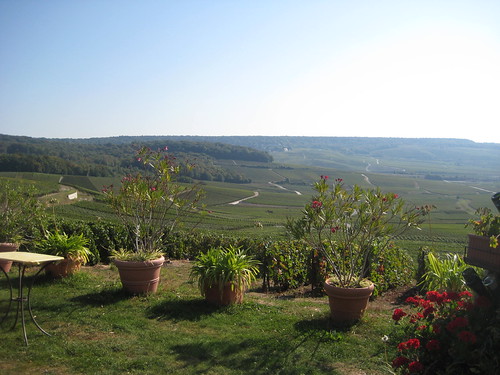
Let’s see, what’s happened so far? We’ve been to Chartres, Blois, all along the Loire valley, up to Mont-St-Michel, Normandy (Juno Beach), Arras (Vimy), Champagne for several days and now we’re in Paris. It’s all been fantastic, it’s all been fun, and it’s all been some kind of otherworldly vacation.

Net connectivity’s been spotty so I’ll have more for you this weekend after we get back. Woo!

Bonjour!

Good morning, North America. Just a quick update from beautiful sunny Normandy. We’re on day 4 of 14, and we’re having a blast. We’ve seen cathedrals in Chartres and Mont-St-Michel, Chateaux at Chambord and Villandry, towns of Candes St-Martin and Saumur and Bayeux, as well as Juno Beach and a thousand points in between. We’ve drunk wine and beer and apple juice and nary a Diet Pepsi. We’ve stayed at some wonderful B&Bs, a parade of one beautiful site and charming host(ess) after another. Both the rental car and my French are holding up fairly well so far; we’ll see what the next ten days bring.

Pictures to come, though I don’t know when. I’m not really inclined to sit at the computer right now. Come to think of it, I think I’ll join Nellie in the sunny courtyard and play with the dogs before dinner. A tout à l’heure!

à tout à l’heure

I went down to the river to scan

Finally overcoming the irony, I managed to summon enough attention to read “Information-rich and attention-poor”, an essay in last week’s Globe and Mail. It’s really quite insightful, and makes clear what so much abundant information is doing to the way we view knowledge:

“Knowledge is evolving from a “stock” to a “flow.” Stock and flow – for example, wealth and income – are concepts familiar to accountants and economists. A stock of knowledge may be thought of as a quasi-permanent repository – such as a book or an entire library – whereas the flow is the process of developing the knowledge. The old Encyclopedia Britannica was quintessentially a stock; Wikipedia is the paradigmatic example of flow. Obviously, a stock of knowledge is rarely permanent; it depreciates like any other form of capital. But electronic information technology is profoundly changing the rate of depreciation…Knowledge is becoming more like a river than a lake, more and more dominated by the flow than by the stock. What is driving this?”

The essay describes very well a problem I’ve been feeling. Well, a change more than a problem per se, but something I’ve sensed. In fact, the author deals with the perception that the shift from a lake to a river is problematic.

“Those of us who are still skeptical might recall that Plato, in the Phaedrus, suggested that writing would “create forgetfulness in the minds of those who learn to use it.” This is a striking example of a particular kind of generation gap in which masters of an established paradigm can only see the shortcomings, and not the potential, of the truly novel.”

I’m very comfortable dealing with this river of information. I’ve jumped right in, obviously, by scanning hundreds of news feeds every day at home and at work and picking out the relevant bits, but I feel like I’ve trained for that my whole life by being a generalist…I like knowing something about a lot of things, and knowing a lot about some things, so all this access to information is kind of like mother’s milk to me. I’ve never been the kind of person who memorized things, I’ve always assumed I could look them up or just figure something out again when I needed to. Now it sometimes feels like I can’t remember enough, especially when I’m at work and dealing with people who still value institutional knowledge.

It is frustrating sometimes, that I can’t sit down and focus on something very often. I find that needing to focus for an hour on conceptual work requires that I move to an empty meeting room, or even a Starbucks, just so I get away from the computer and the need to watch the river. That often means printing something so I can work offline, which I hate. So I figure I have three options:

  1. Build a nice, easy ‘dam’ switch on the computer that lets me disable Outlook, Twitter, Google Reader, IM and my phone for an hour or so
  2. Find a way to work on a paper-like form that doesn’t require killing trees. Maybe it’s time for me to get a tablet?
  3. Quit my job and find something that never requires any original thought or conceptual analysis, just parroting of the information I see which adds little or no value to it. But I’ve never really wanted to be a newscaster, so I guess that’s out.

Chemistry

Tonight my beloved Montreal Canadiens will hit the ice for their first exhibition game of the fall. I’ll miss nearly the entire pre-season, as well as their season opener against the Leafs (blurg!) while we’re in France, but I’m intensely curious about how the team will look.

I’ve held off talking about all the off-season changes Bob Gainey’s made as I wanted to see the final product take shape before commenting. This was the most change I’ve seen my Habs, or maybe any team, go through in one summer. After the disastrous 08-09 season, the centennial celebration in which the Canadiens were supposed to contend for the cup, Gainey knew he had to do something. And what he did was blow up his team’s leadership core and start over.

Saku Koivu, the heart of the team and one of the club’s longest-serving captains, wasn’t signed. Likewise Alex Kovalev, their most talented player and assistant captain. Mike Komisarek and Chris Higgins, both of whom have worn the A and have been projected to eventually don the C, are gone. Alex Tanguay, Robert Lang, Mathieu Schneider, Patrice Brisebois, Tom Kostopulous, Mathieu Dandenault, Francis Bouillon…all gone.

Plenty of players came back in return, and on a talent-by-talent basis they’re as good or better as what went out the door. The interesting part of the great reset of 2009 was the fact that Gainey looked at his core of veteran players and decided he simply wasn’t going to win with that group. Loathe as I am to admit it, he was completely right. There’s been something lacking on the Canadiens team for a long time, something intangible…usually teams use words like chemistry or cohesiveness to describe it. Maybe it was heart. Short of Koivu, who would probably run through walls or kill a hobo if that’s what it took to win, there were a lot of guys on the team who would disappear when their backs were against the wall. But even Koivu, with all the heart in the world, often couldn’t get his name into another gear in crunch time. The effort was there but the execution wouldn’t come.

So, Gainey brought in Scott Gomez, Mike Cammalleri, Brian Gionta, Jaro Spacek, Hall Gill (!), Travis Moen and Paul Mara to reform the bulk of the team. Whether they can produce the chemistry Gainey’s looking for, or whether the departure of the old guard allows others to finally step up, remains to be seen. There are already early whispers of better chemistry in the room, so we’ll see if that sticks. Interestingly, those comments about chemistry came from Carey Price, upon whom success this season hinges more than anyone. If Price doesn’t bounce back from a bad year, all of Gainey’s machinations may be for naught.

However, the time for introspection is passed. The time for hockey is…uh, tonight. I can’t wait to hear the sweet sounds of blades carving ice and boards being rattled.

Go Habs go.