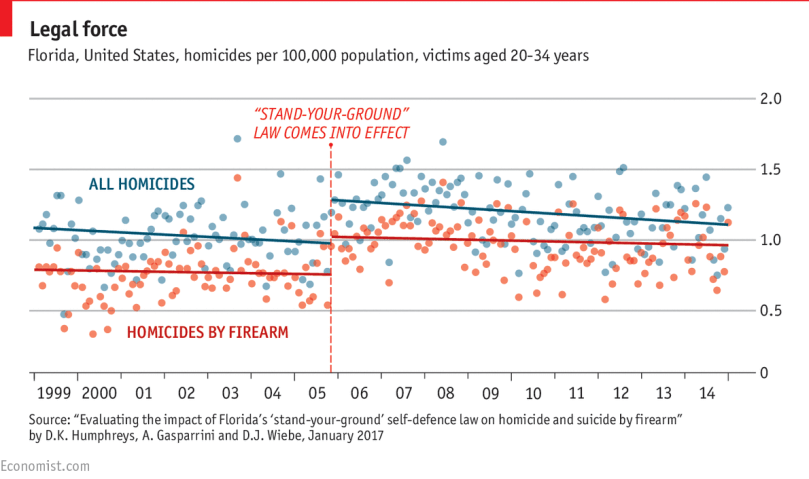
Just in case anyone’s wondering whether “stand your ground” laws increase gun deaths, The Economist has put it into graphic form.
Jesus.
[source: economist.com]
.:.
Cover photo by Mayu, used under Creative Commons license

Just in case anyone’s wondering whether “stand your ground” laws increase gun deaths, The Economist has put it into graphic form.
Jesus.
[source: economist.com]
.:.
Cover photo by Mayu, used under Creative Commons license



I stared at this a lot last night. I mean, not this particular guy’s sweatpants-covered junk, but rather crowds of people all but standing on top of me.
See, Nellie and I went to the Raptors game last night. We hadn’t seen one in a while, and we decided to buy good tickets. After all, it was Andrew Wiggins’ first game in Canada, and against the T-Wolves the Raps were all but guaranteed a win. They did win, but it was closer than it should have been.

Anyway, we discovered when we arrived (after it took us ten minutes just to walk the last 30 feet to our seats) that his gloriousness Stephen Harper was sitting across the aisle from us. That’s his head and torso (and, uh, son) in the bottom right of the picture. The crowds that were clogging up an entire section of the ACC weren’t his entourage, they were — and I still have a hard time even believing this — people lining up to have their picture taken with him.
*Sigh.*
Now, I’ll give the security guys credit: they actually tried to keep the aisle clear during play, as did the ushers. But the selfie-seekers are idiots, and would stand, gape-mouthed and blocking traffic, with Blackberries in hands until they could get a picture with that magnificent head of hair. As such we couldn’t see some of the game, and missed the entirety of the half-time show and on-court entertainment, including Raptor antics which, as everyone knows, are at least 15% of the reason to attend a game.

I actually felt a little bad for Harper…I think he just wanted to watch a basketball game with his kids. But then again, he decided to sit in a place which afforded maximum photo ops. Maybe he should have sat in a box where people wouldn’t bother him and where, oh I don’t know, crowds of people wouldn’t have trampled and blocked the thirty people nearest him who paid good money for their tickets.
The very best part? At some point in the evening he did a photo op with some actual players, and his social media lackey tagged the wrong player.
lolololololol, poor AB, prime minister tags kyle lowry instead. pic.twitter.com/Qb4FsE7YCf
— alex (@steven_lebron) March 18, 2015
Oh, and the idiots next to us had a Wand of Narcissism, which just kind of capped off the evening.
 Maybe the only thing salvaging the evening was meeting up with Kaylea, Jenna, and Jordan over some pizzas at Libretto. We used beer to wash away the distaste.

But still: no more Mayor Ford.
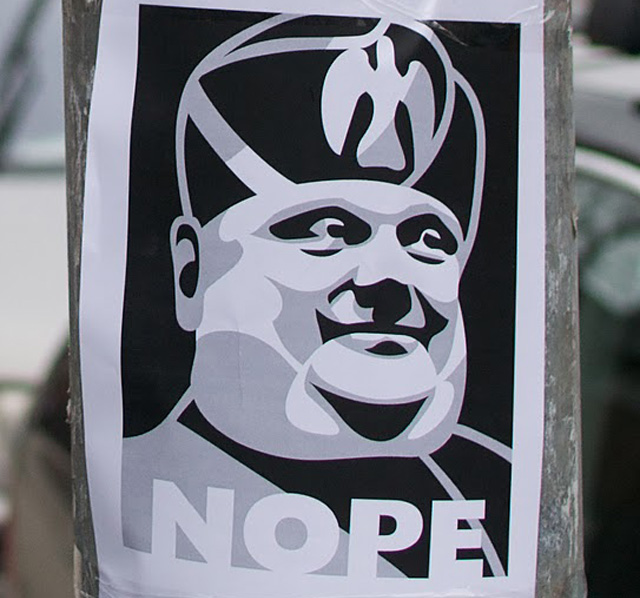
And yes, I’m conflating the two Ford brothers here, but hey…they gave themselves the name Ford Nation.
.:.
Cover photo by Gwydion M Williams, used under Creative Commons license

I’ve avoided writing about Toronto Mayor Rob Ford until now, in part because I’m ashamed and didn’t want to acknowledge it, in part because I assumed it would all end soon (“soon” never happened, obviously), and in part because there’s a disgusting abundance of material out there about him already. Not that I haven’t wanted to write about it, mind you; writing helps me make sense of senseless things, and I’ve been baffled since the day the man became mayor.
I won’t get into the long litany of offenses and outrages committed by His Worship (the standard honorific for the mayor of Toronto) — they’re listed here in a Google Doc. Well, up to November 20th, at least. Certainly mayors and other politicians have resigned for less: Montreal mayor Gérald Tremblay resigned amid corruption rumours. Anthony Weiner resigned from Congress because he got caught tweeting a picture of his clothed junk. And so on.
The immediate push-back from those who still support Ford (more on that later) ran along the lines of, “Who cares what he does in his spare time, he does a good job and tries hard and saves me money.” Forget the national, and international reputation of Toronto being dragged through the mud, so long as he’s saving the taxpayers money, right? So commentators began discrediting his most common talking points: that he has saved the city a billion dollars, that he’s a fiscal conservative, that he’ll stop needless city spending, and that he’s a blue-collar everyman. These, the biggest planks in his political platform, are bullshit. They always have been, but Ford’s supporters no longer had these narratives to fall back on.
And yet this dismantling of his more egregious lies hasn’t changed the minds of Ford Nation: as of three weeks ago his approval rating stood at 42%. This, again, was baffling to me. His behaviour as the city’s ambassador has been embarrassing (believe me, Ford was a prominent news story on CNN International, the BBC, and Al Jazeera while we traveled around southern Africa) and on top of that his actual job performance is a fabrication. How, then, to explain his base of support? It’s undeniable that Mayor Ford (and his brother Doug) are popular in their neighbourhood. Doug handing out $20 bills at a community housing complex doesn’t hurt, but that can’t account for such a large number. And even the most tinfoil-hatted can’t believe this is all a media conspiracy, and rally behind their guy: when the Star, Globe, Post, and Sun all agree that the mayor needs to step down, there’s no media spin left.
Equally wacky, in my opinion, is the theory that suburbanites will support anyone they see as sticking it to the downtown elite latte-sipping liberals. I don’t buy that. I don’t think those 42% are diabolical or scheming, or wish particular harm on everyone south of Bloor. In fact, I don’t think they give much thought to anyone outside their own household. And therein, I believe, lies the problem.
“We have somehow deluded ourselves into thinking that wealth is wisdom.”
The constant refrain from those who still support Ford is that they believe he will reduce, or has reduced, their taxes, in spite of all the evidence to the contrary. The reduction of burdensome taxes seems to be their primary concern. I can understand this, particularly for low-income families. But low-income families don’t account for that 42% who still support Ford (besides, anyone who’s paid attention knows Rob Ford’s tendency over the years has been to cut city services used by the working poor), so it’s not just low-income families. In fact, I have plenty of personal, anecdotal evidence of affluent acquaintances who support Ford solely because they want him to cut their taxes. They acknowledge that he is a buffoon, an embarrassment to the city, and an erstwhile racist and homophobe not reflective of the city’s values, but are willing to overlook all that for the possibility of paying less tax next year. I’m not alone in hearing this either.
Again, this baffled me. These are not idiots who’ve said these things to me, but rather educated and intelligent people. While I knew the basic premise of fiscal conservatism was to reign in government spending, I underestimated the degree to which a) fiscal conservatism has been oversimplified into “taxes are bad, full stop”, and b) people will overlook bad behaviour if a tax break is involved. I couldn’t articulate it until I read a piece in the Guardian last month in which Harry Leslie Smith summed it up perfectly:
“By far the worst error we have made as a people is to think ourselves as taxpayers first and citizens second.”
Suddenly, the lights came on. I got it now. I understood. It’s simplistic, to be sure, but no less reductive than this tax-break-or-else mentality. Some people have made this leap, this assumption, that the primary function of government, trumping all other functions, is to limit itself. This manifests as people referring to themselves as taxpayers, as if that’s all they are. I still believe the primary function of a government is to care for the citizens who elect it. Fiscal responsibility, just like household responsibility, is one of the ways in which it ensures and sustains that care…but not the only way.
I’m not sure this makes it easier to convince Ford Nation, but at least I understand the issue now. I think. Thanks, Mr. Smith.
Last week I read about a trend in the results from the latest US election on Joey DeVilla’s blog (via HappyPlace, via Fox News, all ultimately via the US Census). Basically, the ten most educated states (in terms of percentage of college grads) voted Democrat, while nine of the ten least educated states voted Republican.

Pretty stark, no?
Anyway, the census data also provided average annual income, and I like to see these sorts of thing in visual formats, so I plotted all fifty states, plus DC:

Looks like a trend to me. And there’s clearly a correlation between education level and income, so the fact that the bottom end of the trend is virtually all Republican while the top end is virtually all Democrats runs counter to the Republican insinuation that Democrat policies are geared to welfare moochers.
Oh, and in case you’re wondering about those outliers, the especially-highly-educated Democrats are in Delaware, and the very-highly-paid Republicans are in Alaska.
.:.
Photo by swirlspice, used under Creative Commons license
Being sick and having little energy usually results in me watching a lot of movies. To wit:

What he said.
“It is time to stop listening to the voices who plead for calm moderation and for a cotton-candy centrism that melts at the first sign of resistance. It is time for politicians on the other side to be as fervent in their calls for economic justice as Newt Gingrich is in his calls for kiddie janitors and adolescent wage-slavery. It is time for someone — anyone — to step to a very big microphone and say that the problem with Americans is not that they are lazy, or coddled, or anesthetized by 70 years of the welfare state, or morally unmoored (Thanks, David Brooks!), but that the problem with Americans is that a bunch of expensive suits stole all their money, looted their pensions, made a mockery of their hard work, and labored for decades to develop dozens of ways to swindle them, all the while fashioning a politics that told them that the ultimate freedom was the freedom to have your pockets picked.”
Charles P. Pierce, on esquire.com

 Skirl | Dan Dickinson